
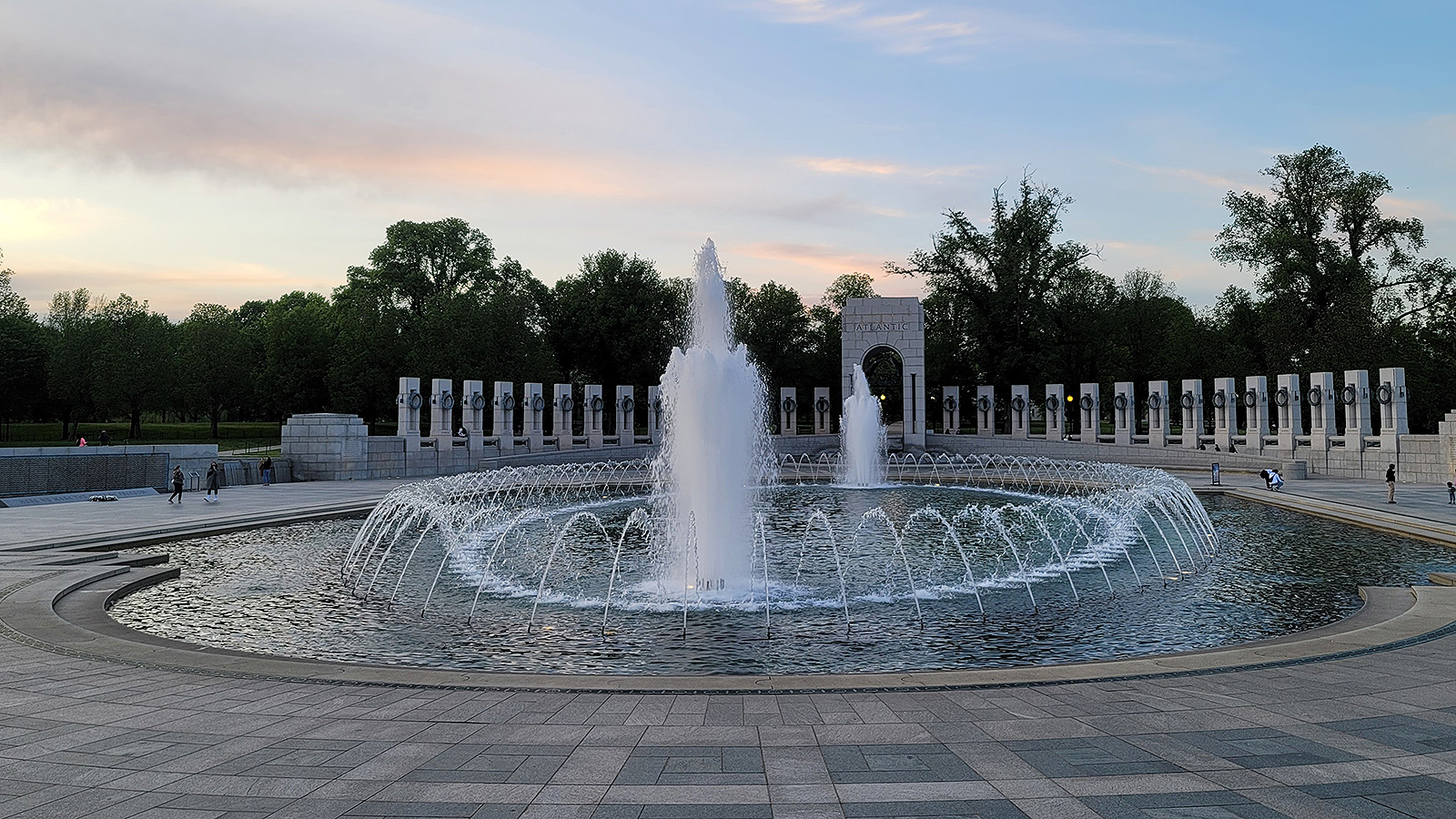
The World War II Memorial sits between the Washington Monument and Lincoln Memorial, using fountains, 56 pillars, two triumphal arches, and a wall of gold stars to connect military service with the national landscape. It is free and open 24 hours, making early morning and blue hour practical for photography. The central limitation is not access but conduct: this is an active commemorative space where ceremonies, veterans, and families take priority over symmetry, tripods, or an uninterrupted frame. Nearby parking is limited during busy National Mall days.
World War II Memorial quick facts
- Operator
- National Park Service, National Mall and Memorial Parks
- Address
- 1750 Independence Avenue SW, Washington, DC
- Hours
- Open 24 hours; ranger presence commonly runs 9:30 a.m.–10 p.m.
- Admission
- Free
- Best light
- Early morning for lower crowds; blue hour for fountains and illuminated stone
- Useful lenses
- 24–70mm for the plaza; 70–200mm for reliefs, pillars, and axial compression
- Closest pairing
- Washington Monument and Lincoln Memorial
- Facts last verified
- July 29, 2026
What does the design represent?
The memorial’s 56 granite pillars represent the 48 states, seven federal territories, and District of Columbia that made up the nation during World War II. The Atlantic and Pacific arches organize the two major theaters of war. Along the Freedom Wall, 4,048 gold stars honor the more than 400,000 Americans who died; each star represents 100 service members.
Those facts change how the place should be photographed. A row of pillars is not merely repeating geometry, and the stars are not a decorative backdrop. Read the inscriptions and relief panels before deciding what belongs in the frame. The memorial’s story includes military service, industrial labor, the home front, grief, and collective remembrance.
Where are the strongest compositions?
From the east entrance, the plaza opens toward the Rainbow Pool and Lincoln Memorial. A standard zoom can balance the pool, arches, and western axis. From the west, turn back toward the Washington Monument and use the fountain as a foreground. A longer lens compresses an arch, pillar, and distant landmark without forcing you into ceremonial space.
The bas-relief panels along the north and south ceremonial entrance walls reward slower attention. Use a normal lens or short telephoto and keep the sculpture square to the sensor when detail matters. The Freedom Wall is more effective as a quiet, carefully exposed study than as a selfie background.
How should a photographer behave during a visit?
Yield immediately to wreath layings, Honor Flight groups, veterans, school programs, and private remembrance. Do not direct strangers, climb on stone, place equipment against inscriptions, or use the fountain edge as a gear table. Keep a respectful distance from anyone reading names or leaving a tribute.
Ordinary visitor photography generally does not require a permit. Larger crews, exclusive use, or activity that affects other visitors may require National Park Service authorization. Even a permitted project must follow site-specific restrictions. In a busy plaza, handheld photography is usually faster, safer, and less intrusive than a tripod.
When does the light work best?
Early morning provides a quieter plaza and soft light moving across the granite. Midday can be visually hard, but it reveals texture in the relief panels. At blue hour, expose carefully so the fountains retain detail and illuminated stone does not clip to white. Wind can scatter spray, so keep the front element dry and change position rather than repeatedly wiping it in the center of visitor flow.
The memorial is exposed to summer heat and sudden storms. Stone surfaces become slick when wet. Use the broad paths, avoid the temptation to step backward while watching a screen, and leave during lightning.
How do you reach the memorial?
Public transportation and a longer walk are normally easier than nearby parking. Metered spaces may be available on Constitution Avenue NW and West Basin Drive SW, while lot parking is farther south at the Paddle Boat area. Accessible parking and a bus loading zone are available along Home Front Drive SW. Conditions change during major events, so check National Mall alerts before arrival.
Official sources and updates
- National Park Service: World War II Memorial design and history
- National Park Service: fees, parking, and permits
- National Park Service: directions and transportation
- National Park Service: National Mall photography permits
Related DC reading
Photograph the eastern axis with the Washington Monument guide, continue west with the Lincoln Memorial guide, or place both into the complete National Mall photo walk.