
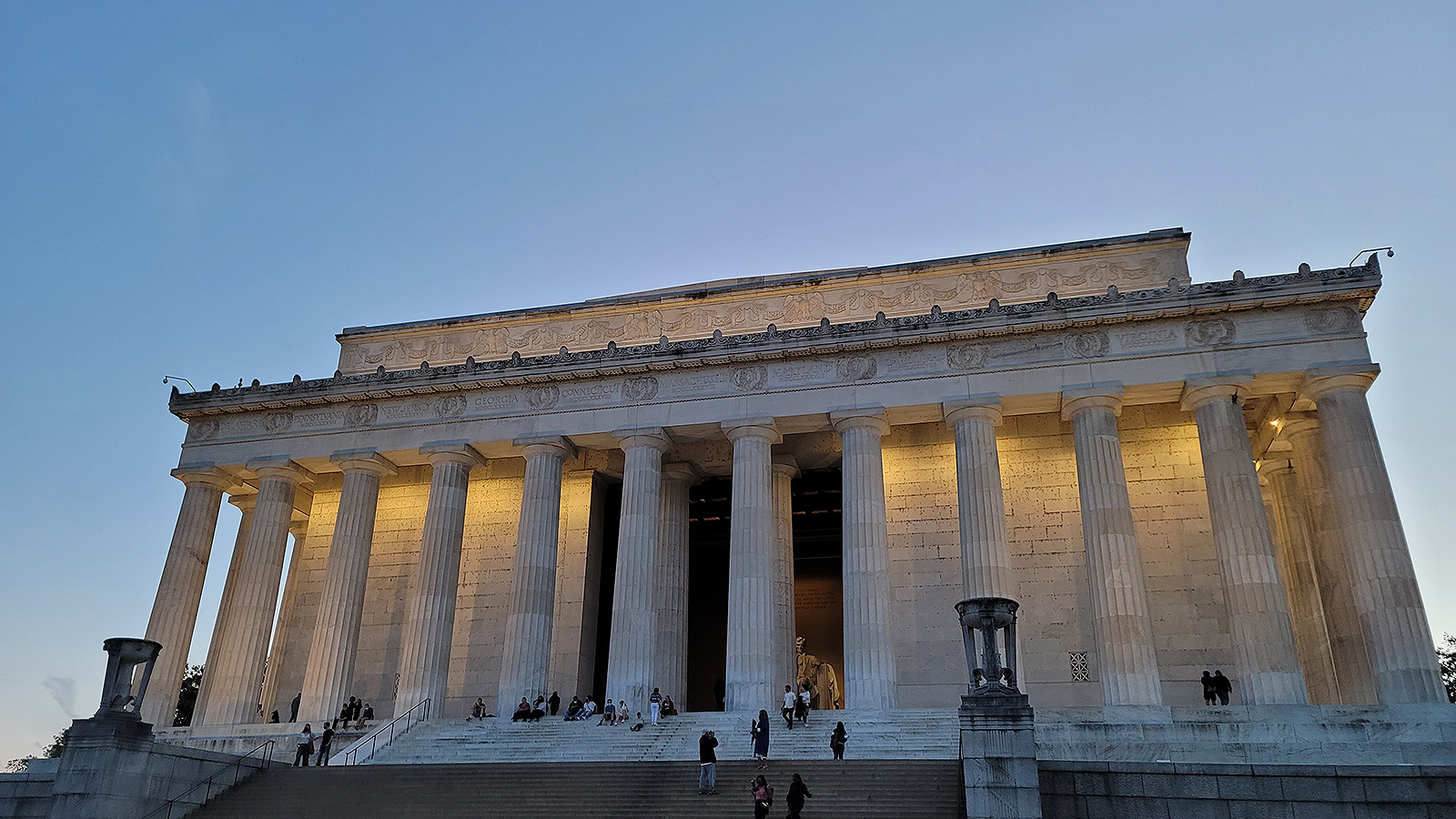
The Lincoln Memorial rewards two different photography plans: quiet morning architecture from the Reflecting Pool axis, or blue-hour frames that connect the chamber, steps, Washington Monument, and moving city. The memorial chamber is free, open around the clock, and accessible by elevator. The important 2026 change is below it: the new undercroft museum requires a timed ticket, security screening, and a separate schedule, so do not confuse that reservation with ordinary access to the statue and inscriptions. Parking nearby remains limited, making transit the practical choice.
Lincoln Memorial photography quick facts
- Operator
- National Park Service, National Mall and Memorial Parks
- Address
- 2 Lincoln Memorial Circle NW, Washington, DC
- Main memorial
- Free and open 24 hours
- Undercroft museum
- Timed ticket required for visitors age 2 and older
- Best light
- Early morning on the east-facing façade; sunset and blue hour for the civic axis
- Useful lenses
- 24–70mm for architecture; 70–200mm for Reflecting Pool compression; phone 1× or 2×
- Closest Metro
- Foggy Bottom–GWU, approximately 0.8 miles away
- Facts last verified
- July 29, 2026
Where should the first frame be made?
Begin east of the memorial with enough distance to include the Reflecting Pool, steps, and columns. Early morning gives the façade direct light and usually fewer people. A longer lens can compress the memorial against foreground reflections, while a standard lens preserves the open space. When wind breaks the reflection, use the pool edge or elm rows as leading lines instead of waiting for glassy water that may never arrive.
On the steps, turn east. The view aligns the Washington Monument and distant Capitol, but the strongest frame is not always the highest one. Test several elevations and keep railings level. Inside the chamber, expose for the white marble statue and darker wall inscriptions rather than allowing the phone to brighten every shadow.
When does blue hour work?
Arrive before sunset to find a position without blocking stairs, ramps, or the chamber. As the sky darkens, the illuminated columns gain contrast and the eastward view begins to balance with the Washington Monument. A tripod may be unnecessary in a crowded space; modern stabilization and a modest ISO increase often produce a sharper, more respectful result.
Ordinary visitors documenting a trip generally do not need a photography permit. Larger groups, exclusive setups, equipment that affects other visitors, or more complex work may require National Park Service review. Whatever the permit status, no setup earns priority over accessible routes, ceremonies, or visitor flow.
What changed with the Lincoln Memorial undercroft?
The undercroft and museum opened to the public in June 2026. Advance tickets are available up to 30 days ahead through Recreation.gov, with new inventory released at 11 a.m. daily. Tickets are free, but an advance reservation has a $1 service fee. Free same-day tickets are distributed from the Korean War Veterans Memorial kiosk beginning at 8:45 a.m. while supplies last.
All visitors age 2 and older need a ticket for the undercroft, and security screening is required. The exhibit is a separate photography environment with concrete structural columns and interpretive displays. Follow posted rules, protect other visitors’ space, and do not plan a tripod-dependent interior shoot.
How accessible is the memorial?
An elevator on the left side of the main stairs reaches the chamber. The National Park Service reports seven accessible parking spaces on Daniel Chester French Drive with a two-hour limit, plus accessible restrooms south of the memorial. The undercroft includes accessible restrooms, tactile features, captions, and an audio-described experience.
General parking nearby is extremely limited. Foggy Bottom–GWU is about 0.8 miles away; Smithsonian Metro is roughly 1.2 miles away. Bicycles and scooters have designated parking near the memorial but cannot be ridden inside it.
Official sources and updates
- National Park Service: Lincoln Memorial accessibility
- National Park Service: directions and transportation
- National Park Service: undercroft tickets and visitor information
- National Park Service: National Mall photography permits
Continue the memorial sequence
Approach from the World War II Memorial to work the full Reflecting Pool axis. The National Mall photo walk provides the complete east-to-west itinerary, while the Hains Point loop offers a quieter waterside alternative.